Ammonium Sulfate: Powder, Granule, and Crystal Forms, Applications, and Differences
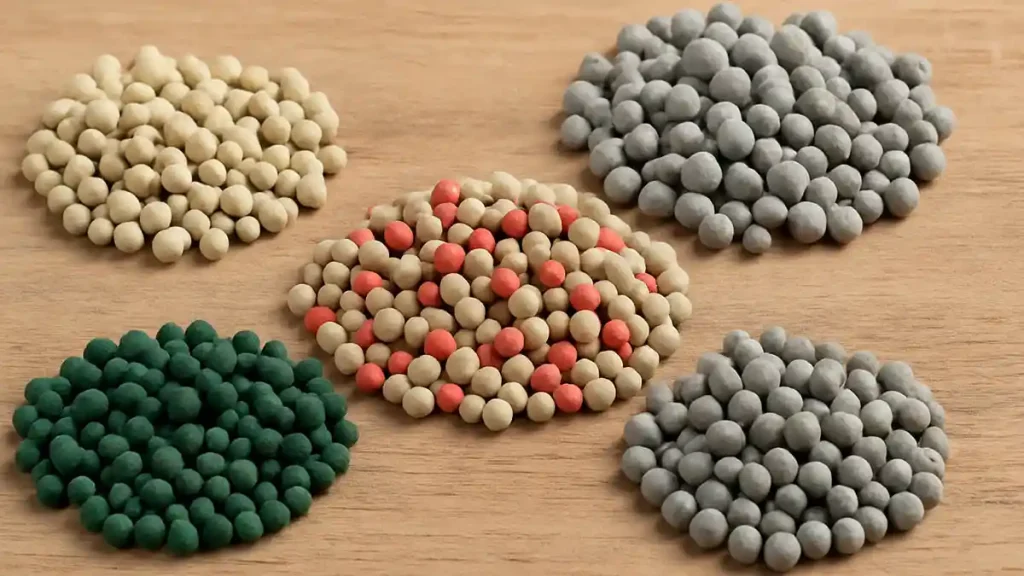
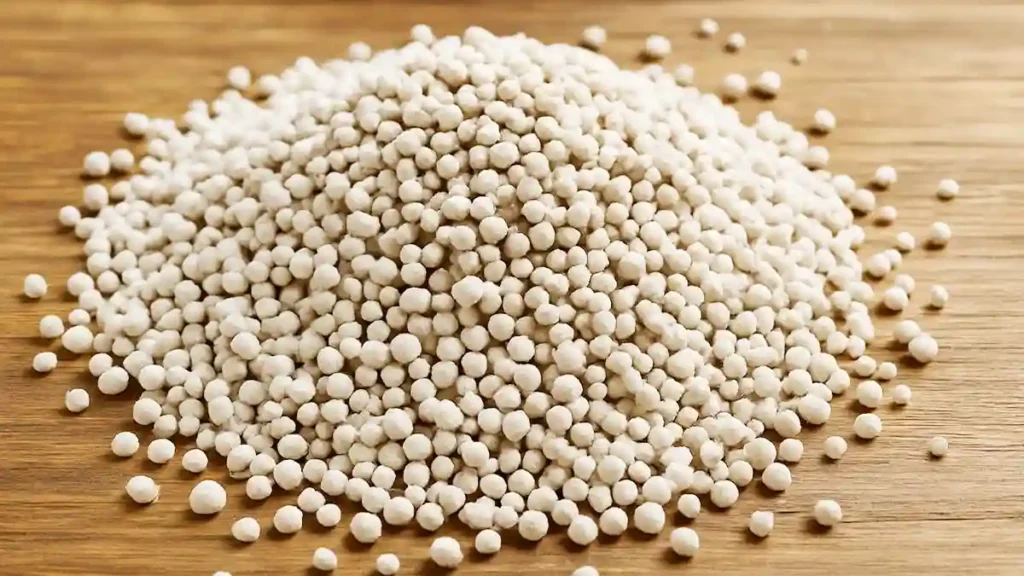
Ammonium sulfate, with the chemical formula (NH₄)₂SO₄, is produced by reacting sulfuric acid with ammonia. This inorganic salt contains 21% nitrogen and 24% soluble sulfur and is available on the market in powder, crystal, granule, and liquid forms.
Ammonium Sulfate Fertilizer Specifications
| Property | Value |
|---|---|
| Chemical Formula | (NH₄)₂SO₄ |
| Nitrogen Content | 21% |
| Sulfur Content | 24% |
| Solubility | Water-soluble |
| Form | Granule, Powder, Crystal |
| Color | White |
| Packaging | 50 kg bags, 1-ton jumbo bags |
| Country of Production | Iran, Uzbekistan, Russia, China |
Agricultural Ammonium Sulfate Granules
The first and most important use of ammonium sulfate in agriculture is as a chemical fertilizer. Thanks to its soluble sulfur content, it is highly suitable for alkaline and calcareous soils and helps improve soil structure and reduce pH.
In addition, because the nitrogen in this fertilizer is in the ammonium form (NH₄⁺), and ammonium, unlike nitrate, has a positive charge, it binds well with soil particles and is not easily leached or volatilized, unlike urea.
Although urea contains 40% nitrogen, its nitrogen is quickly converted and can be lost more easily. Under strong summer sunlight, urea can also convert to ammonia and evaporate rapidly from the soil surface.
Therefore, ammonium sulfate has several advantages over urea, and it is recommended to read a comparison of chemical nitrogen fertilizers for a deeper understanding.
Rate and Timing of Ammonium Sulfate Application
The application rate and best timing depend on the type of crop, growth stage, and soil type. For optimal use, follow the recommended application guidelines below.
Recommended Application for Orchard Crops
It is better to use ammonium sulfate in late spring or late summer. Avoid applying it in late autumn, since it may stimulate excess growth and increase the risk of winter damage and disease.
After application, weed growth should be controlled so that the crop can develop properly. This fertilizer should be applied at 45- to 60-day intervals. Since it is absorbed relatively quickly into the soil, it should be reapplied every 4 to 6 weeks.
Forms of Ammonium Sulfate
What Is Granular Ammonium Sulfate and What Is It Used For?
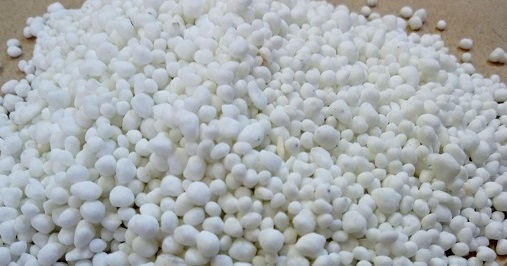
Granular ammonium sulfate is a widely used chemical fertilizer. It is produced and sold in granular form and contains two essential nutrients for plant growth: nitrogen (about 21%) and sulfur (about 24% as sulfate).
Because of its granular structure, it offers better stability and more uniform spreading, and it dissolves slowly in the soil. This makes granular ammonium sulfate especially suitable for mechanized agriculture and machine-based broadcasting.
Agricultural Uses of Granular Ammonium Sulfate
-
Supplying readily available nitrogen
The nitrogen in this fertilizer is in ammonium form (NH₄⁺) and plays an important role in vegetative growth, protein production, chlorophyll formation, and increased leaf area.
-
Improving alkaline soils
Due to its acidic nature, granular ammonium sulfate helps reduce soil pH in calcareous and alkaline soils, improving the availability of micronutrients such as iron, zinc, and manganese.
-
Providing sulfur for sulfur-loving crops
Sulfur is essential for the synthesis of amino acids such as cysteine and methionine. It is especially important for sulfur-demanding crops such as onion, garlic, rapeseed, and legumes.
-
Improving crop quality
Proper use of this fertilizer can improve the taste, color, oil content, or protein content of agricultural products, such as in wheat, sugar beet, and oilseed crops.
-
Suitable for a wide range of crops
Granular ammonium sulfate can be used for field crops, orchard crops, turf, fruit trees, and vegetables.
Click to read more:
Usage Notes
- Apply this fertilizer at the right time, such as early in the growing season.
- In acidic soils, use with caution because it can further increase soil acidity.
- Combining it with organic fertilizers or other fertilizers may improve its performance.
What Is Crystal Ammonium Sulfate?
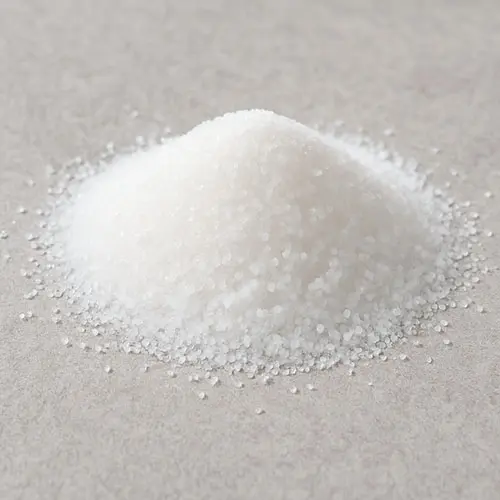
Crystal ammonium sulfate is an inorganic compound with the chemical formula (NH₄)₂SO₄. It appears as white, transparent, odorless crystals. It is one of the most widely used sulfur and nitrogen compounds in various industries.
Ammonium sulfate is fully soluble in water, and the pH of its aqueous solution is usually slightly acidic (around 5 to 6).
This compound is typically produced by reacting ammonia with sulfuric acid. Due to its chemical stability, good storability, and high solubility, it is used in both agriculture and industrial applications.
Physical and Chemical Properties
| Property | Value |
|---|---|
| Chemical Formula | (NH₄)₂SO₄ |
| Nitrogen Content | About 21% |
| Sulfur Content | About 24% |
| Physical Form | White or colorless crystals |
| Water Solubility | Very high |
| Aqueous pH | 5 to 6 (mildly acidic) |
| Flammability / Odor | Non-flammable, odorless |
Applications of Crystal Ammonium Sulfate
1. Agricultural Uses
- Nitrogen fertilizer: provides rapid nitrogen and sulfur supply to plants.
- Improves alkaline and calcareous soils.
- Suitable for drip irrigation and fertigation systems due to its high solubility.
2. Industrial Uses
- Pharmaceutical industry: used to precipitate proteins and purify enzymes in biochemistry, in the well-known salting-out technique.
- Food industry: used as a permitted food additive (E517) to regulate pH or control fungal growth in industrial products.
- Textile and dyeing industry: used as an assisting agent to help fix dyes on fibers.
- Water and wastewater treatment: used to remove heavy metals, adjust pH, and reduce excess nitrogen from industrial effluents.
3. General and Laboratory Uses
- Used in biological and biochemical laboratories for purifying proteins, antibodies, and enzymes.
- Used in battery and chemical industries as a source of ammonium ions in specific reactions.
- Used in the production of fire-retardant, flame-resistant, and anti-fungal materials when combined with other chemicals.
Key Advantages
- High storage stability
- Can be blended with other fertilizers or materials
- Excellent water solubility
- Suitable for fertigation and precision agriculture
- Supplies both nitrogen and sulfur simultaneously
What Is Powdered Ammonium Sulfate?
Powdered ammonium sulfate is the finely ground form of ammonium sulfate fertilizer. It dissolves faster than the granular form and is often used where rapid nutrient availability is needed.
Advantages of Powdered Form
- Faster dissolution in soil and water
- Suitable for quick application in certain irrigation systems
- Easier mixing in fertilizer blends
- Useful when a more immediate nutrient response is needed
Considerations
- May be more prone to uneven broadcasting compared with granules
- In windy conditions, fine particles may be harder to spread accurately
- Should be stored in dry conditions to prevent caking
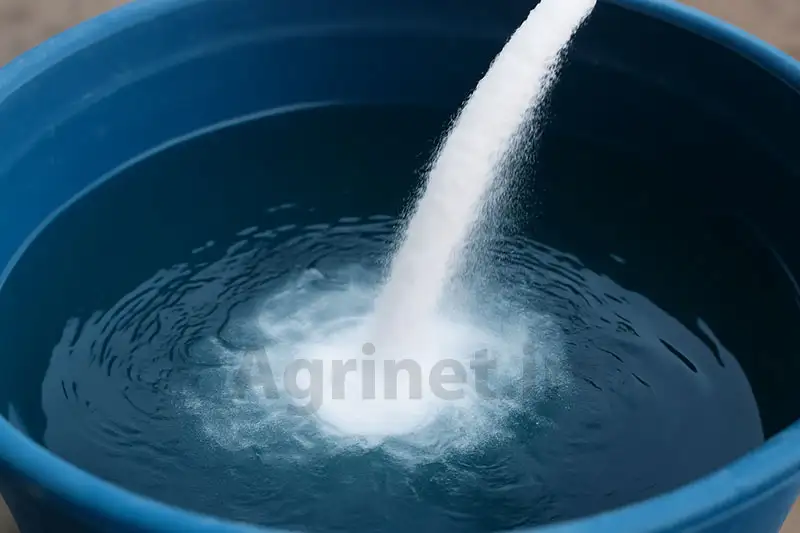
Differences Between Granular, Powder, and Crystal Ammonium Sulfate
Granular Form
Best for:
- Mechanized farming
- Broadcasting over fields
- Slow and uniform release
- Orchard and field crops
Powder Form
Best for:
- Fast mixing
- Soil amendment applications
- Blending with other fertilizers
- Situations where quick dissolution is preferred
Crystal Form
Best for:
- Fertigation
- Drip irrigation
- Industrial and laboratory uses
- High-purity applications
Ammonium sulfate is one of the most useful nitrogen and sulfur fertilizers in modern agriculture. Its 21% nitrogen content, 24% sulfur content, high water solubility, and acidifying effect make it especially valuable for alkaline and calcareous soils.
Whether used in granular, powder, or crystal form, ammonium sulfate can help improve crop growth, soil nutrient availability, and agricultural productivity. It is also widely used in industrial, pharmaceutical, food, textile, and laboratory applications.
If used correctly and at the right time, ammonium sulfate can be an effective solution for improving both soil health and crop quality.